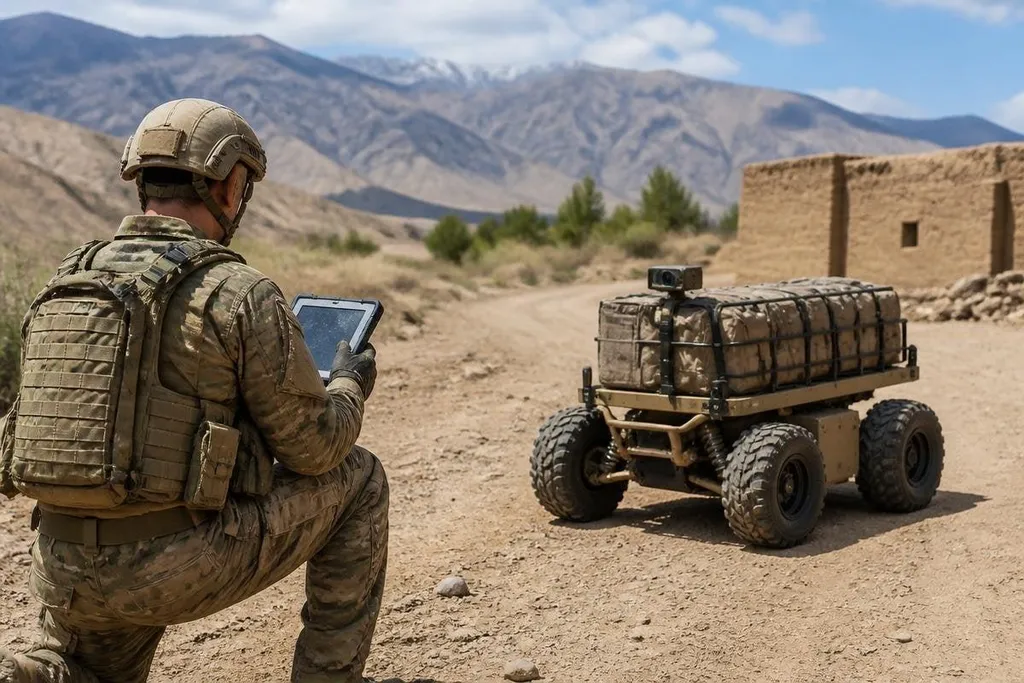
Military robots will likely take on more transport, scouting, and route-planning work. The harder question is who remains responsible when a robot loses its link, reads a scene wrongly, or meets a person outside its training data.
- Human approval should remain tied to any use of force.
- Autonomous navigation can help when radio links fail.
- Maintenance, recovery, and software updates will shape field use.
Where robots fit first
The clearest path is work that puts people in danger without asking a robot to make a lethal choice. That includes carrying supplies, checking routes, moving equipment, and watching fixed areas with cameras or other sensors.
These jobs still need careful design. A transport robot must know where it can travel, how much weight it can carry, and what happens when its battery runs low. A scouting robot must label uncertain sensor readings instead of treating every shape as a threat.
Remote control will remain useful, though it depends on a working communications link. If terrain, distance, weather, or interference breaks that link, the robot needs a safe behavior such as stopping, returning to a known point, or waiting for a new command.
Autonomy has a narrow safe lane
Autonomy means a system can act without a person directing every movement. That can help with route planning, obstacle avoidance, and keeping a vehicle on course. It does not settle the harder question of whether a person or object may be attacked.
A military robot should be able to separate movement from force decisions. The first can run on onboard software. The second needs a clear human chain of command, a record of the order, and a way to stop the system before harm occurs.
The risk grows when several systems share sensor data and pass tasks between them. A false reading in one system can become a bad route, a wrong alert, and a rushed response. Engineers will need tests that include blocked cameras, missing location data, damaged wheels, and delayed commands.
The link and the repair problem
A robot that works only beside its operator has a smaller job than one expected to work far away. That makes communications part of the robot, not a separate detail. Operators need to know what the system saw, when it last received a command, and why it chose its current action.
Repair matters just as much. Batteries, motors, wheels, cameras, antennas, and protective covers can all fail during use. A fleet that needs factory staff for every fault will spend more time waiting than moving, even if the software works as planned.
A field report should tie the robot to its test site, operator, repair record, and fault. Robotics coverage from Robot24.com can give you those details before you compare a military robot’s claims with its work in the field. That record also matters when you calculate the costs beyond the purchase price.
The price is also hard to judge without verified program data. A purchase figure alone leaves out spare parts, operator training, secure communications, software support, transport, and recovery after a breakdown. Any serious forecast needs those costs beside the robot's purchase price.
What remains unproven
No evidence pack is supplied here, so this article makes no claim about a named military program, unit count, price, date, or test result. That limit matters.
Public demonstrations can show that a robot completed one task; they don't prove that it can repeat the task under poor visibility, damaged hardware, or hostile communications.
I'd be wary of any forecast that treats more autonomy as the main measure of progress. A system that stops safely, reports uncertainty, and lets a trained operator take control may be more useful than one that acts alone but cannot explain its choice.
The same standard applies to force. A robot should not receive permission to act merely because its sensors produce a confident label. The chain from sensor reading to human order to physical action needs records that people can inspect after an incident.
A buyer's checklist
Before funding or approving a military robot, ask:
- Define the task: Can a person state the job in one sentence?
- Test lost links: What does the robot do after commands stop arriving?
- Set human control: Which actions require a named operator's approval?
- Check failure reports: Does the system show sensor errors, low power, and damaged hardware?
- Price the full system: Are training, repairs, spares, secure communications, and recovery included?
That checklist shifts attention from a robot's most polished demonstration to the conditions that decide its use. The next useful proof will be repeated tests with broken links, blocked sensors, and human approval recorded at every force decision.